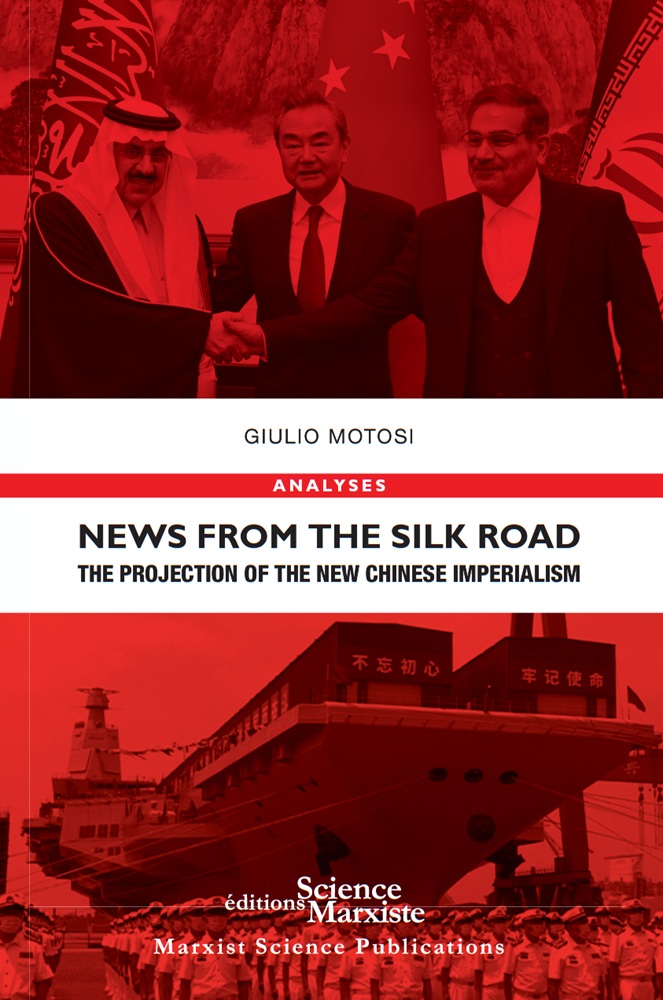
Twenty years ago, China joining the World Trade Organisation (WTO), the euro about-turn in Europe, and the wars of American decline were the political facts which inaugurated a new strategic phase. China, a power emerging from the backward areas that were shared out and developed by imperialism, went so far as to challenge the post-war order and to demand a new partition of the world. This transition, taking place in the twilight – but not yet the fi nal breakdown – of the old order, together with the classic silent accumulation of contradictions which paves the way for every great chemical reaction in history, had to be accurately studied. We needed to pay special attention to the variants and nuances of Chinese foreign policy, the pluralism of its schools of thought, and the way that their orientations adapted and changed over time. In the absence of any serious systematic effort among Western sources, we decided to review some of the main threads of China’s vast number of publications on current affairs. No dominant political current in China has declared the breakdown of the old order as one of its immediate goals. However, on the whole, even those most reluctant to let go of the old dosages of peaceful rise and liberism are, in the end, aligning themselves with the relentless trend of Asian rearmament. It is only a matter of time, they think – counting aircraft carriers, nuclear warheads, and latest generation fighters – before the rearmament race leads to an Asian regional war, like those in Ukraine and Gaza that attest to the crisis in the world order. Marx and Engels had predicted China’s capitalist development and Lenin’s analysis advanced the analytic tools necessary to predict its imperialist development in the 20th century. In the post-WWII period, by re-establishing the link between these threads of analysis on the uneven development of capitalism in the imperialist phase, it was possible to situate the Dragon’s industrialisation – and, prospectively, its establishment as a power – in the strategic approach of our Leninist party. With China having reached imperialist maturity and a huge Asian proletariat having formed, these strategic factors, destined to disrupt the post-WWII imperialist order, have appeared as predicted. For the first time, a worldwide upheaval of huge proportions is arising from the Chinese power’s imperialist collision. Marxism alone was able to foresee, far in advance, such a dialectic of the “historic collision” and, for two centuries, to maintain a clear focus on the “curious spectacle […] of China sending disorder into the Western World”.This will result in a collision like none ever seen before in the world order of the ruling classes.
21 Chapter One
FROM THE EXPORT OF CAPITAL TO THE STRUGGLE FOR SPHERES OF INFLUENCE
23 New Groups of China’s “Open Door” Policy
29 Dual Silk Road for Imperialist China
34 China: a “Responsible Power” With Missiles and Aircraft Carriers
40 Flag and Trade Along the Silk Road
46 Naval Bases and Aircraft Carriers for the Capitalists of Beijing
51 “Global Times”, “Financial Times”, and “Nikkei” to Battle Stations
56 Beijing Debates Its Imperial Projection
61 China’s Moon Landing Reveals Rivalries and Alliances
66 Pluralist Schools for the Great Restructuring and Multipolarism
73 Chapter Two
CHINA TESTS EUROPE ALONG THE SILK ROAD
75 A Chinese Look at European Politics
81 Close Encounters Between Beijing and Berlin in Africa
87 Congress of Corporations and Mergers in the Railway Industry
93 China Sounds Out the Mediterranean
98 Third-Party Markets Are the Prize in the New Global Partition
104 “China 2025” and “Germany 2030”
110 China: EU’s “Partner” and “Rival”
115 China’s Two European Hands
121 Chapter Three
ON THE MARCH TOWARDS THE PERSIAN GULF ENERGY ARTERY
123 The “Long March” of Chinese Imperialism
128 The Dragon Is Also Targeting the Persian Gulf
134 The Carter Doctrine Is Not Enough to Harness the Dragon
139 Trump’s Hasty Retreat Benefits Beijing
145 “Pedagogical” Blow in the Gulf and Chinese Shadow Play
150 The Chinese Dragon Refuses to Be Tethered in the Pacific
155 Beijing Faces an Uncertain Carter Doctrine
161 Chapter Four
THE SOUTH CHINA SEA BETWEEN THE NERVE CENTERS OF IMPERIALISM
163 Chinese ‘‘Long March’’ According to Wang Wen
168 Wang and the Unprecedented Secular Change
174 Appointment in the South China Sea After the Presidential Election
180 Nerve Centre in the South China Sea
188 Beijing Awaits Biden in the Indo-Pacific
193 Beijing Winks at Biden’s “Middle Class”
199 Chapter Five
THE “TWO HANDS”: WARS AND PARTITION ON THE STRATEGIC HORIZON
201 The CAI Accord Strengthens the “European Party” in China
207 Two Hands Against Two Hands
213 “Two Hands” and “Two Paths”
218 China’s “Quasi-Alliance” in the Persian Gulf
223 The ‘‘Two Hands’’ of the Chinese Military
228 The Dragon Does Not Wait for American Rearmament
234 Taiwan Is Another Key Issue in the World Contention
240 Land and Sea in the Multiple “Linkage” Between the US and China
246 Washington and Beijing Mobilise the Military-Industrial Complex
251 Chapter Six
REARMAMENT AND DIPLOMACY FOR THE CRISIS IN THE WORLD ORDER
253 Ukrainian Lessons According to Beijing
258 Anti-Chinese Repertoire in US Microchip Laws
264 Beijing’s Calibrated Neutrality in the First War of the “New Era”
270 Beijing Is Also Prioritising Rearmament
275 Guangdong Supports Inclusive Multilateralism
281 A Decisive Decade for the Rise of the Chinese Dragon
286 Warning Shots in the Taiwan Strait
292 Beijing Distances Itself From Moscow
297 Chapter Seven
CHINA AND THE US: MIRROR-IMAGE SUPERPOWERS
299 From Chinese Modernisation to the Persian Gulf
304 China Deals With Many Americas
310 A Dangerous Decade for Productivity
315 Tirpitz and Kautsky in Beijing
321 Two Fleets to Negotiate
327 Portsmouth and Kyiv
333 Chapter Eight
A NEW TYPE OF “OPENING UP” IN THE GLOBAL PROJECTION
335 Nemesis of the “Open Door”
341 Beijing, Shanghai, and Guangzhou in the New Chinese Opening Up
346 Beijing Pushes BRICS Plus Forward
351 Jin Canrong’s “Great Contention”
357 Beijing Puts Pressure on Washington Over Gaza
362 China, India, and the War in Gaza
369 Chapter Nine
ASIA PREPARES FOR WAR
371 The Spratly Islands Among the Focal Points
377 Asia’s Unstoppable Rearmament Around the Dragon
383 The US and EU’s Lost Decade to China
389 Biographical Index of Names
427 Bibliography
437 Index of Economic Entities

ISBN 978-2-490073-81-8
series : analyses
€20.00 or $24.00 or £20.0